

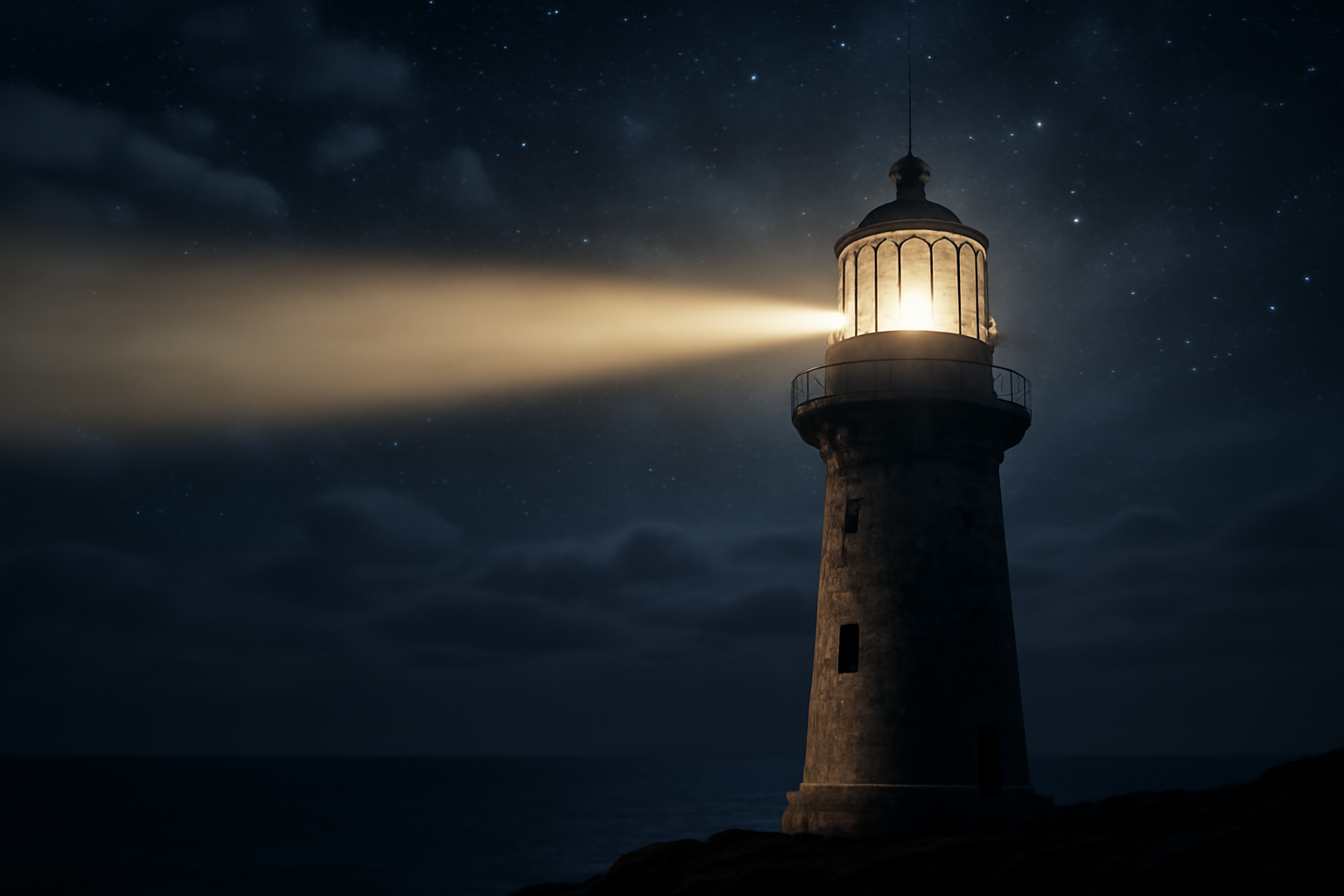
By the time Daniel Shaw inherited the lighthouse, everyone who remembered it working was either dead or too old to care.
From the ferry, it looked like a broken tooth jutting out of the coastline—a narrow stone tower clinging to a cliff, its lantern chamber long since gutted and glassless. The sea around it was a sheet of pewter, the sky a flat, clouded gray.
“Last stop,” the captain grunted. “You sure about this place, professor?”
Daniel adjusted his glasses and tried not to drop his suitcase as the boat bumped the dock. “As sure as my lawyer was to remind me the property taxes are three years overdue.”
The captain snorted. “Most people sell the Shaw Light as soon as they get the papers. You’re the first one I’ve seen going toward it.”
“I just want to see it,” Daniel said. “My father grew up here. I never met him, but…”
He trailed off. The captain nodded like he understood. Maybe he did.
“Just remember,” the old man said quietly, “that lighthouse was turned off for a reason.”
The cottage that came with the tower was cramped, crooked, and smelled of old wood and colder winters. Dust lay thick over everything: the iron stove, the bookshelf, the narrow bed. In the corner, an oilskin-wrapped bundle waited on a table, left there by the lawyer.
Inside, Daniel found a ring of keys, an envelope with his name in a hand he didn’t recognize, and a brass pocket watch with a cracked face.
The letter was short.
Daniel,
If you’re reading this, then you’ve ignored good advice.
The lighthouse is not a house. It is not even, in the way people think, a light.
You’re a scientist. You’ll try to measure things. That’s fine. Just remember: the light doesn’t point at ships.
It points at moments.
Be careful which ones you call.
– E. Shaw
“Mom always said her brother was dramatic,” Daniel muttered, but the words lodged in his throat.
He turned the pocket watch over in his hand. Someone had etched a set of coordinates into the back, along with a time: 03:17.
He checked his phone. It was 15:42.
Plenty of time to prove all of this was nonsense.
The interior of the lighthouse was a spiral of stone steps and stale air. His footsteps echoed as he climbed, hand sliding along a rusted iron rail. The higher he went, the more he felt it: a faint vibration in the stone, like the memory of distant thunder.
The lantern room at the top was empty except for an iron pedestal in the center and a ring of tall, narrow windows looking out over the sea. The pedestal had no lamp, no Fresnel lenses, no gears. Just a basin of polished metal, tarnished with age, and four shallow grooves pointing outward at cardinal directions.
Daniel placed his fingertips on the rim.
The metal warmed under his touch.
He snatched his hand back, heart kicking. The room was cold, his breath faintly visible. There was no reason for the metal to be warm.
He exhaled slowly and set his laptop bag down, pulling out a portable EM sensor and a small thermal camera. If there was residual electrical infrastructure somewhere in the walls, he would find it and satisfy his rational brain.
He got readings, all right.
The EM levels around the pedestal spiked, showing a concentrated field that didn’t match any wiring pattern he knew. The thermal camera showed the metal basin glowing just slightly warmer than the room—then flickering hotter in brief pulses that matched nothing he was doing.
“Huh,” he said.
The pocket watch in his coat pocket vibrated softly.
He pulled it out. The cracked hands didn’t point to the current time. They pointed to 03:17, as if frozen there.
He frowned. “You’re just stuck.”
The second hand twitched.
He stared.
“Okay,” he said slowly. “New plan.”
He set up a tripod in the corner and aimed a camera at the pedestal, then checked the time again. Sunset had stained the clouds with streaks of pale pink. He could spend the night in the cottage and come back for a proper survey in the morning.
His hand brushed the edge of the basin one last time.
The lighthouse hummed.
It wasn’t a sound; it was a feeling. The stone and metal vibrated together in a low, harmonic resonance. Dust lifted from the floor in a faint, swirling pattern.
The air thickened.
Daniel’s ears popped, like pressure in a plane cabin. For a second, the view out the windows blurred—not fog, not rain, but something else, like water disturbed in a glass.
He stepped back, pulse pounding.
“Just old stone settling,” he whispered.
The pocket watch vibrated again.
This time, he opened it.
The cracked face seemed deeper than before, as if the hands sat at the bottom of a narrow well. The time still read 03:17. The second hand ticked once.
Outside, the light changed.
The sky, moments ago washed with evening colors, darkened to a near-black dome. Stars wheeled above—wrong stars, brighter and unfamiliar configurations that made his brain ache to look at them.
The sea glowed faintly, as if lit from below by distant, wandering lamps.
A ship appeared out of nowhere.
One moment, the horizon was empty. The next, a black silhouette cut across it—a three-masted vessel, sails full though no wind moved the water near shore. Its lanterns burned a pale, greenish light that cast no reflection.
Daniel’s breath hitched.
His first instinct was to blame some kind of projection, but there was no beam, no distortion, no source. The ship moved with the heavy, deliberate motion of reality. He could hear faint shouts, the crack of rope against mast, the slap of waves against hull.
He stumbled to the nearest window, pressing his palms to the cold glass.
The ship sailed in an arc that felt… precise. Deliberate. As it reached a certain line on the water, the pedestal in the center of the room pulsed with sudden heat.
The ship flickered.
For an instant, it became skeletal—planks rotted, sails torn, a ruin held together by stubborn memory. Then it snapped back, whole and solid again, and sailed on toward a point in the darkness.
The pedestal cooled.
The ship vanished.
Not gradually. Not into fog.
Just gone.
Daniel backed away from the window.
“The light doesn’t point at ships,” he whispered, recalling the letter. “It points at moments.”
The pocket watch’s hands shifted.
Now they read 21:07.
The current time.
Sleep was a lost cause.
He ransacked the cottage after midnight, searching for anything that could explain what he’d seen. The old logs in the dusty cabinet held the usual mixture of weather notes and routine maintenance entries.
Then, buried at the bottom of the stack, he found a leather-bound journal with his uncle Elias’s name embossed on the cover.
The entries began mundane, years back: discussions of bills, loneliness, the stubborn streak of the coastal storms.
Then, several months before the lighthouse had officially been decommissioned, the tone changed.
March 3
I tried to turn it on. Thought the stories were exaggeration. They weren’t. The first ship came through just after sundown. Wrong flags. Wrong stars. Men shouting in a language I recognized and yet didn’t. I don’t think it was ours.
March 5
The light isn’t light. It’s a… focus. The old keepers used to say it “pulled things home.” I don’t think it pulls them home. I think it pulls them into alignment.
March 19
Saw a ship of glass tonight. Literal glass. Too sleek to be any navy I know. It flickered in and out like bad reception. Crew looked up here like they could see me. I put my hand on the basin and everything snapped into clarity. Felt wrong. Like I’d forced something into a track it wasn’t meant to take.
April 2
I’ve stopped using the basin unless I have to. The more I do, the more I feel the pull. It doesn’t just show, it chooses. And sometimes it chooses things that are still coming.
Daniel flipped pages, pulse accelerating.
May 11
A storm rolled in out of nowhere, clear radar one hour, total chaos the next. The light in the basin lit by itself. I saw a ship I’ve never seen on any record—sleek, black, no sails. Our name painted on the side in lettering we haven’t invented yet. I think it was ours. I think it was from our future. I shut the light off. I don’t want to know how that ends.
May 20
If anyone finds this: don’t stand at the basin when the watch reads 03:17. That’s when it looks this way instead of us watching that way. The sea remembers us. And something out there is still looking.
The last entry was a single line.
June 1
I turned it off. I think. If you feel it hum again, run.
Daniel closed the journal.
It hummed.
Very faintly, through the floorboards.
Like something waking from a long nap.
He climbed the steps with the pocket watch clenched tight in his hand. Each turn of the spiral seemed steeper than before, his legs heavier. The hum grew louder the higher he went—not noise, exactly, but a vibration that lived in the hollow spaces of his bones.
The lantern room was darker now, though the windows showed a clear night sky. The stars overhead were the stars he knew again, sharp and cold.
The pedestal gleamed with an inner dull shine. Another object sat on its rim that hadn’t been there before.
A small, round disk of metal, no bigger than a coin, etched with concentric circles.
He reached for it, then hesitated.
The pocket watch in his hand had changed again.
The hands were spinning.
They whirled around the cracked face, faster and faster, until they blurred. Then they slammed to a stop at 03:17.
The room’s pressure shifted.
Outside, the sea darkened into ink. A low fog rolled in from nowhere, obscuring the horizon. The hum of the lighthouse rose to a high, shivering note.
With a soft, almost polite click, the basin lit from within.
It was not a beam in the usual sense: no cone of light swept across the water. Instead, the air above the pedestal distorted, as if space itself had been pinched and pulled.
Through the distortion, he saw something that wasn’t the sea.
Rows of lights stretching out to a curved edge. Not stars—windows, perhaps, or portals. A hull of impossible size, blacker than the space around it, moving slowly, majestically.
He realized he was not looking out.
He was looking up from the perspective of something far below.
The lighthouse was aligning with a moment—not on Earth, but somewhere else. Somewhen else.
The giant structure passed overhead in a slow, silent eclipse. A voice—not sound, but meaning—brushed against his mind like a cold fingertip.
Anchor found. Temporal coordinates acquired. Beacon confirmed.
The words weren’t in English, but his brain translated them anyway. His knees nearly gave out.
The vision snapped. The pedestal dimmed.
Outside, the fog thinned. The sea looked like itself again.
The pocket watch hands shifted to the current time.
Daniel sagged against the nearest wall, heart hammering so hard it hurt.
The lighthouse hadn’t just shown him ships slipping through their own histories. It had just synchronized with something enormous, somewhere in the deep architecture of time.
Something that now knew exactly where—and when—the beacon was.
He thought of his uncle’s last entry.
If you feel it hum again, run.
He looked at the pedestal. At the coin-shaped disk, still resting on its rim, faintly warm.
He picked it up.
On its underside, etched in painfully neat letters, were three words in English.
“THIS ONE IS OURS.”
He didn’t sleep that night.
He sat in the lantern room until dawn, watching the sea, listening to the faint, dying heartbeat of the failing mechanism under the floor.
By the time the first light of morning edged the waves in silver, he’d made his decision.
He could report the lighthouse, hand it over to the government, let them turn it into a research facility or a weapon.
Or he could stay.
He looked down at the pocket watch—at the coordinates, at the memory of that vast shadow moving overhead.
The beacon was old. Unstable. Fading. But it still worked. And something out there now knew that.
“Not yet,” he whispered to the empty room. “You don’t get to choose how this story ends without us.”
He slipped the coin into his pocket, set his hands on the basin, and began to map what moments the light could reach.
The old lighthouse had never guided ships at all.
It had guided contact.
And for now, he would be the one to decide who—or what—made it through.